Showing posts with label Tax. Show all posts

22 January 2012

Six reasons why you must file your tax returns and then lists out the virtues of why you must not hide interest income earned while filing tax returns.


When it comes to filing of income tax return, the most common views that we encounter as tax experts are thus:
  • My employer has deducted tax at source on the salary income received by me hence I don't need to file my income tax returns!
  • Government has stated that individuals who earn below Rs 5 lakh income need not file income tax returns!
  • I work hard & hardly find time. When spending time with family is rare, why waste time on filing income tax returns.
  • The deadline for filing tax returns is far away, why bother now!
  • I have anyway missed the deadline for filing tax returns (July 31), so now it does not matter whether I file the returns or not!

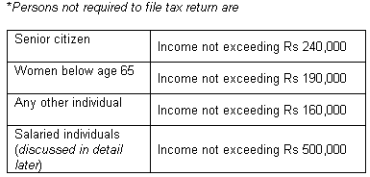
Though these are the very popular views people have, the truth is much different. Technically any person* who has total income in excess of the threshold exemption limit is mandatorily required to file her/his income tax return.
Here are six reasons why you must file your income tax returns
1. Early bird gets the best
In case you are of the opinion that the last date for filing, that is, July 31 is a far call now and you could afford to rest, beware. It's always best to finish of this chore at the earliest so that you do not get into the crosshairs of the last minute rush filers and make a mess of the tax return.
Begin your preparations and execute your return filing process as soon as possible.
2. A stitch in time saves nine
Even if you have missed the July 31 deadline, you can go ahead & file your tax return immediately without any further delay. Penal interest is applicable for delayed filing, ONLY IF you have any pending tax liability.
Suppose your entire tax liability has been paid up before March 31, 2011 then there is no penal interest liability for you to take care of at the time of filing your returns.
In case there is any pending tax liability as on March 31, 2011 then the penal interest increases with each month of delay in filing your tax returns.

3. Fail to file and pay the price
In case you fail to file your tax returns at least before March 31, 2012, you may be liable to pay a penalty of Rs 5,000.
Also, tax returns are subject to time barring provisions, that is, currently you cannot file tax returns for any years preceding financial year 2009-10.
Hence it becomes pertinent you start filing tax returns immediately.
4. Create history, file tax returns
When you file your tax returns every year, you manage to create your financial record with the tax department.
This financial / tax history is positively viewed and favourably used by most agencies with whom you may need to interact, such as when you avail any kind of loan (home, personal, vehicle loan, etc), when you apply  for VISA etc.
5. Proof of (financial) life
Income tax return is essential for making any investment and goes to prove that you have a valid source of income to make such investment.
6. New rule, added confusion
The tax department has notified that individuals with salary income below Rs 5 lakh are not required to file their tax return subject to certain conditions* being met. Though this move would benefit the new entrants to employment, for others this rule is nothing but increased confusion in deciding whether to file tax return or not.
*Conditions for exemption from filing tax return under Rs 5 lakh rule
1. Single employer income
2. Savings account interest up to Rs 10,000
3. PAN should be correctly declared to the employer
4. Employer should have deducted tax on both salary & savings account interest
Accordingly, an individual who has income from multiple employers OR FD / term deposit interest OR house, wherein she/he is claiming interest deduction would need to file her/his tax return.
Considering the above pointers, filing your tax return seems to be a GOOD IDEA rather than saying, filing tax returns? NO IDEA.
src:rediff
Follow I Love India on Facebook:
Like this Post??? Share it:

20 May 2011

Pay your commercial taxes anytime, anywhere online through e-remittances from six banks - SBI, SBM, SBH, Syndicate Bank, Canara Bank and Union Bank of India, without physically approaching an office of the Commercial Taxes Department in Karnataka

Karnataka today became the first State in the country to launch an e-payment system for commercial tax payers.
Speaking at the launch, Reserve Bank of India Deputy Governor Shyamala Gopinath wanted such a system to be adopted by other States.
The system enables dealers to remit their commercial taxes anytime, anywhere, without physically approaching an office of the Commercial Taxes Department (CTD). 
Karnataka Chief Minister B.S. Yeddyurappa launched a comprehensive e-Payment system for Commercial Taxes Department in Bangalore on Thursday. Photo: K. Gopinathan.

Right now, e-remittances can be made from six banks - SBI, SBM, SBH, Syndicate Bank, Canara Bank and Union Bank of India.
Follow I Love India on Facebook:
Like this Post??? Share it:

08 May 2011

Investment under Section 80C to save tax : PF & VPF, PPF, NSC, ELSS, Life insurance premiums, Home loan,Stamp duty, registration charges, Fixed deposits (FDs) and Interest paid on education loan

To encourage savings, the government gives tax breaks on certain financial products under Section 80C of the Income Tax Act. The section helps you save taxes on investments up to 1 lakh - if you are in the highest tax bracket of 30%, you can save Rs 30,000 in taxes. Here are the options available under the section:
PF & VPF: Provident Fund (PF) is deducted from your salary. Your employer also contributes to it. While the employer's contribution is exempt from tax, your contribution is counted as investment under Section 80C. You can also contribute additional amounts to Voluntary PF (VPF). The EPFO has announced a 9.5% rate of return on deposits for 2010-2011. Also, the interest earned on the investments is tax-free.

Public Provident Fund (PPF): A PPF account can be opened with a nationalised bank or a post office. The rate of interest earned is 8%, which is tax-free, and the maturity period is 15 years. The minimum required contribution is Rs 500 per year and the maximum allowed is Rs 70,000.

National Savings Certificate (NSC): This is small-savings instrument for a period of six years. The rate of interest is 8%, compounded half-yearly. The interest accrued every year is liable to tax, but the interest earned is also deemed to be reinvested and, thus, eligible for tax deduction.

Follow I Love India on Facebook:
Like this Post??? Share it:

02 March 2011

A salaried person would not have to file tax returns??? , change in the 80CCF tax benefits???,

Is it true? No more filing of tax returns for the salaried
In his Budget announcement the Finance Minister said “The electronic filing of Tax Deduction at Source (TDS) statement has stabilized. The Board shall soon notify a category of salaried taxpayers who will not be required to file a return of income as their tax liability has been discharged by their employer through deduction at source.”  Does that mean we don’t have to go through the ordeal of filing returns anymore? Wondering whether the tax slab for woman also increased? Here are some of your queries on the Income Tax announcements answered.
Q: Is it true that a salaried person would not have to file tax returns any longer?
There is a proposal to exempt certain class or classes of persons from furnishing the return of Income. Salaried employees with only income from salary could fall under this category. The relevant notification in this regard will be issued soon. This is a good development if institutions such as housing finance companies, banks etc. treat the Form 16 as a good proxy for the ITR. Otherwise I suggest you file the ITR even if you fall under the exempt category. 
Q: The tax exemptions for an individual has increased from Rs 1,60,000 to Rs 1,80,000 does that mean woman’s exemption limit has been hiked to 2,10,000 from its earlier 1,90,000.
Unfortunately, there is no change in the basic exemption limit for women below the age of 60. It remains at Rs. 1,90,000. Women above the age of 60 can avail a basic exemption limit of Rs. 2,50,000. 
Q: The FM announced that the Direct Tax Code would be effective from April 2012. How would this be different from the Income Tax Act?
For individuals there is a change in the computation of short term capital gains on equity shares, taxation of debt mutual funds, list of eligible instruments available for tax benefit under section 66 (currently Section 80C)etc. Also, the eligible amounts for basic exemption and tax related investments may undergo a change.
Q: What has been the change in the 80CCF tax benefits.
The tax benefit of Rs 20,000 under section 80CCF has been extended for one more year.
Follow I Love India on Facebook:
Like this Post??? Share it:

Brief synopsis of the Finance Minister's Budget for 2010-11 : Main points and highlights

The main impetus of the budget is to improve the growth rate and get it to 9 percent in the near term and to a double digit rate in the medium to longer term. The other two areas of focus are Infrastructure development especially in Rural India and Improving Governance by shoring up Systems and bringing stricter control on institutions.
10 Indians share their budget expectations 
 
Key points of the budget:
The government is very keen on ensuring that inflation is curbed and food security is ensured for all citizens.
Food items: Since inefficient distribution has been found to be the culprit for the sky rocketing of food prices, the FM has proposed to focus on reducing Production and Distributions bottlenecks. Food, vegetables, Meat etc will show an easing of prices in the medium term future.
Education: A higher allotment of funds in the form of over 24% hike as compared to last year for the Education Sector.

Full Coverage: Budget 2011

Income tax: More modernization of the taxation system is being mooted. A new form called "SUGAM" will make it easier for small tax payers to file their returns.
A miniscule hike of Rs 20000 in the exemption limit for tax payers has been introduced. The older citizens can feel happy as the FM has decrease the income tax "senior citizen" definition from age 65 to age 60 thus giving a big benefit to those born between 1946-1951. And for those who survive all the hardships of life and lvie to be over 80 they get a higher limit!!
IT sops in budget; air travel, health check-up to be costlier
Deduction of Rs 20000 for infrastructure bonds has been retained.
The direct taxes code which has been proposed to be implement from Aril 1, 2012. This has been in the offing for quite some time and is expected to make taxation simpler. The wait continues.
Sharad Pawar hails Budget as farmer-friendly
Direct transfer of Cash subsidy to be given to people below poverty line so that delivery of Kerosene, LPG and fertilizers happen in a more efficient and accountable manner
Selling off PSU's: Continuing the focus on divesting government stakes in Public Sector Undertakings the FM has proposed to look at raising Rs 40000 Crores from divestment in 11-12
Foreign Investment: The business environment is set to improve for Foreign companies as the government is looking at further liberalizing the FDI policy. More Foreign Direct Investment can only be good for the economy. Way to go…
Investment in infrastructure will go up since FII investment in corporate bonds has been raised. Better roads, Bridges are on their way.
Housing Loan: Loan limit has been enhanced to Rs 25 Lakh for housing under priority sector lending. Interest subsidy (subvention) of 1% on housing loan has been liberalized. People in the lower financial spectrum to get benefit from Mortgage Risk Guarantee Fund.
Agriculture: Higher allotment uinder Rashtriya Krishi Vikas Yojana of Rs 7860 Crores could see more support for the agriculture sector. Special focus on Vegetables in the form of Rs 300 crore for Vegetable initiative. Agriculture credit too raised to Rs 475, 000/- crores. Happier farmers could mean lower prices for the common man. Focus on Cold Chains and Storage could also lead to efficiency and in return reduction in prices and better quality vegetables reaching our kitchens.
Infrastructure is King: Rs 214000 Crores has been allotted for infrastructure for 2011-12. An increase of over 23% over the last year. We can see better highways and transport systems in the near future which could lead to reduction in inflation in the longer term.
Bring the money back: As expected the FM has taken note of the hue and cry over Black Money. Many new initiatives have been mooted to bring back black money in circulation.
Air travel and Medical aid to cost more: Service tax on air travel has been hiked. Hospitals with over 25 beds will have to pay tax on all services. So those posh hospitals could be giving you higher bills in the coming year.
Follow I Love India on Facebook:
Like this Post??? Share it:

The MCD has given an opportunity to tax defaulters : property tax payment last date extended to March 31 2011

Seeking to increase its revenue and give an opportunity to tax defaulters, the MCD today extended till March 31 the last date for its two ongoing schemes for settlement of property tax cases.
    
Chairman of Standing Committee Yogender Chandolia said on public demand, MCD has extended the last date of the scheme for settlement of ex-parte assessments under old system of assessment (rateable value) as well as the unit area method.
     
The schemes were to be closed yesterday.
     
"The extension of time period will help the defaulting taxpayers who could not avail of the opportunity so far. The settlement scheme provides waiver of interest and penalty amount, subject to up-to-date payment of property tax. The taxpayers would be required to pay only the actual amount of tax accruable each year," an official said.
The old RV system continued till March 31, 2004 after which the unit area method was introduced from April 1, 2004.

There are about one lakh cases pending under the old system.
    
In the RV system, the capital value of the property was used to be taken into account while in the unit area method, value is assigned to colonies rather than individual properties.
    
The cash-strapped civic body is keen to collect more property tax, which is its main source of revenue.

The collection has been below the initial target this financial year, prompting the civic body to revise the target

src: ndtv
Follow I Love India on Facebook:
Like this Post??? Share it:

Tamil Nadu cuts sales tax on petrol by 3 percent : the government will be forgoing an annual revenue of around Rs.210 crore because of this move while the price per litre of petrol will come down by Rs.1.38

Chennai, March 1 (IANS) Even with the global crude prices on the upswing, poll-bound Tamil Nadu Tuesday reduced the sales tax on petrol by three percent to 27 percent.
In a statement issued here, Tamil Nadu Chief Minister M. Karunanidhi said oil marketing companies in India are forced to increase the selling price as the crude prices in the international market are going up.

According to him, the state government has decided to come to the help of two-wheeler owners with a tax rate reduction as it they who will be the most affected by the fuel price hikes.

He said the government will be forgoing an annual revenue of around Rs.210 crore because of this move while the price per litre of petrol will come down by Rs.1.38.
Follow I Love India on Facebook:
Like this Post??? Share it:

Premium healthcare to be costlier with new service tax, the total sum of the hospital bill including the cost of medicines and consumables will increase by 10%

Finance minister Pranab Mukherjee proposed amendments in service tax and extended it more areas. Earlier, 117 segments were under service tax, now the unchanged rate of 10% tax on services will be levied on 320 more which is amajor concern for the hospitals coming up in the country.
The amendment has been termed 'ambiguous, impractical and illogical' by experts in the healthcare industry as it will make healthcare all the more costlier than it is today.
As per amendments in the budget, service tax has been widened to cover some categories of hospitals and diagnostic tests. AC hospitals with more than 25 beds have been brought under the ambit of service tax. Healthcare industry experts have termed this as an 'improper' step.
Dr Milan Chag, a leading cardiologist and managing director of The Heart Care Clinic and Care Institute of Medical Sciences, said,
"The imposition of new service tax for treatment in any air-conditioned hospital with a bed capacity of more than 25 means adding 10% to patients' total hospital bill. This is illogical and improper. Ultimately, the end consumers, i.e. patients, suffer as this will automatically raise their bill by 10%," said Chag.
In most cases, of the total bill, 50-70% cost is of medicines and consumables and these cannot be defined as 'services'. However, with this additional new tax, the total sum of the hospital bill including the cost of medicines and consumables will increase by 10% which is an unfair hike, explained Dr Praful Pawar, CEO, Apollo Hospitals.
Industry sources say that the finance minister needs to think hard on this proposed amendment. The government must modify it and exclude medicines and consumables from the total bill, say healthcare industry experts.
Pankaj Patel, chairman and managing director, Zydus Cadila, said, "Overall, the budget is a stability-oriented one with thrust on infrastructure and allocations for healthcare sector.However, the new service tax would hamper the growth of the healthcare industry."
Echoing a similar view, Dr Vikram Shah, director, Shalby Hospital said, "This proposed new tax would burden the patients. And to avoid the increase in the costs, the healthcare service providers would not prefer to fall under the organised sector. This amendment if not modified would kill the growing segment of healthcare industry."
Follow I Love India on Facebook:
Like this Post??? Share it:

27 February 2011

Axis Bank customers holding ATM/ Debit Cards can use this facility to pay Income Tax/ Other Direct Taxes using Axis Bank ATMs.

Axis Bank, India’s third largest private bank, today announced the launch of the facility to pay Income Tax at ATMs. This facility, initially, will be available at select ATMs in the major centers and will shortly be made available at all 5,600 plus ATMs across the country. Axis Bank customers holding ATM/ Debit Cards can use this facility to pay Income Tax/ Other Direct Taxes using Axis Bank ATMs.

The Central Board of Direct Taxes (CBDT), as a part of its e-Governance Initiative to provide more convenience to the taxpayers had advised authorized Banks to roll out the facility to pay Tax using ATMs. Axis Bank is the first private sector bank to make this facility available for its large tax-paying customer base.
Follow I Love India on Facebook:
Like this Post??? Share it:

25 February 2011

The Bombay high court has allowed the Maharashtra Chamber of Housing Industry (MCHI) builders to deposit service tax collected from buyers of under construction structures directly in the court instead of putting the same in an escrow account.

Hearing a petition filed by the apex body of real estate developers, the Bombay high court has allowed the builders to deposit service tax collected from buyers of under construction structures directly in the court instead of putting the same in an escrow account.
The service tax thus deposited in the high court would be refunded to the members of Maharashtra Chambers of Housing Industry (MCHI) along with accrued interest thereon if the decision goes in favour of the builders who have challenged the levy of service tax imposed by the union government.
The division bench comprising justice J P Devdhar and Justice Mridula Bhatkar ordered the relief in service tax case while hearing the writ petition field by the MCHI against the Union Government of India on February 18, 2011.

The MCHI and other builders’ bodies challenged the constitutional validity of the Finance Act 2010, seeking to amend the Finance Act 1994, introducing an explanation to section 65 (105) (zzq) and 65 (105) (zzzh) to introduce the Service Tax concept of ‘Deemed Service” for any commercial or industrial construction of residential complex done prior to obtaining completion certificate.

The division bench of the Bombay High Court comprising Justice V C Daga and Justice S J Kathawala admitted the petition filed by the MCHI and others on July 23 and had granted interim stay until further hearing.

The MCHI in its Writ Petition urged the honourable High Court to restrain the respondents (Union of India and others) from any manner taking steps against the members of MCHI in respect of the transactions for constructions, development and sale of immovable property under the various provisions of the Finance Act, 1994 and a new entry as amended by the Finance Act 2010 in any manner.

President of MCHI Mr. Sunil Mantri has stated that the centre and the state have separate domains in respect of its taxing powers under the constitution.

The state has the exclusive power to levy taxes on land and buildings in terms of Entry 49 of List ii to the seventh schedule of the constitution, by amending the provision to levy service tax on transaction of sale of immovable property is seem to be unconstitutional. 

Mr. Mantri stated that the sale of an unit in the complex as per the settled law of transfer of property is not a service. Accordingly sale of the same by the builder should not be treated as a service since service tax is levied ultimately on the property. This would be a tax on transfer of immovable property only.

Mr. Mantri is of opinion that such a levy will increase the cost of the flat and ultimate buyer will have to bear the cost. The National Housing and Habitat Policy 2007 envisage affordable housing for all. The proposal to levy service tax irrespective of any kind of house (even EWS or MIG) would run counter to the policy of the government.  

MCHI president Sunil Mantri, in a statement, said the sale of a unit in a complex as per the settled law of transfer of property is not a service. Accordingly, sale of the same by the builder should not be treated as a service since service tax is levied ultimately on the property. This would be a tax on transfer of immovable property only.
Mantri opined that such a levy will increase the cost of the flat and ultimately the buyer will have to bear the cost. The National Housing and Habitat Policy 2007 envisages affordable housing for all. The proposal to levy service tax irrespective of any kind of house (even EWS or MIG) would run counter to the policy of the government.
Follow I Love India on Facebook:
Like this Post??? Share it:

24 February 2011

Reliance Industries (RIL) may have to pay 30 per cent tax on the income accruing to it from the $7.2-billion deal with British firm BP. However, BP — the world’s fourth-largest energy company — will not be liable to pay tax to the Indian government on the deal, as it does not involve the transfer of shares.

Experts and tax officials that Business Standard spoke with said the deal was different from some past deals such as Cairn-Vedanta and Vodafone-Hutch, as it involved a transaction of assets. Therefore, RIL will have to pay corporation tax on its business income. They are, however, divided on whether RIL would have to pay capital gains tax on the deal.
“RIL is selling something and BP is buying something. So, it is not a case of international taxation and BP will not have to pay any tax. RIL is not selling a controlling interest, but only a share in their blocks. RIL’s books of accounts will have to be seen to figure out if there are any capital gains to RIL on giving BP a stake in those blocks. Also, it will have to be seen whether these blocks are treated as capital assets or something else,” said a finance ministry official, who did not wish to be identified.
On Monday, BP had announced it would buy 30 per cent in 23 of RIL’s oil & gas blocks, which including KG-D6 off the east coast. The two also agreed to future performance payments of up to $1.8 billion and a 50:50 joint venture to source and market gas, which could take the total investment to $20 billion.
RIL did not respond to an e-mail query on the matter. “This is an asset deal and not a share transaction like Cairn-Vedanta. So, the income will accrue to RIL, but the actual tax liability would depend upon its corporate tax position (its losses). Besides that, there will be capital gains tax of 20 per cent with indexation. So, the effective tax liability may be just 20 per cent,” said Gokul Chaudhuri, a partner with BMR Advisors.
Any exploration cost not written off for tax purposes provides an offset in the computation. As regards the balance receipt, the asset, having been held for over three years, is expected to qualify as long term and, hence, attract concessional rate of capital gains tax.
A tax expert, on the other hand, said there would be no capital gains tax in this case because the transaction is guided by a specific provision under Section 42 (2) of the Income-Tax Act. “This is a farm-in transaction for BP and farm-out for RIL. Whatever consideration is received, the total exploration expenditure is reduced from that for tax purposes. The remaining exploration cost is not allowed. It has already claimed some expenditure,” said the tax expert.
In the past, the income-tax department has raised a tax demand in several cross-border transactions. It has been involved in a legal battle with Vodafone for its acquisition of Hong Kong’s Hutchison Telecommunications stake in Hutch Essar for over $11 billion in 2007. It is also examining various cross-border mergers & acquisitions, including deals by Vodafone, Genpact, Barclays, Intelnet, Sanofi and AT&T, to understand their tax implications.
Follow I Love India on Facebook:
Like this Post??? Share it:

Power Finance Corporation (PFC) declared the launch of its income tax saving infrastructure bond today with the offering set to raise Rs 5300 crore, the biggest among all recent bond issuances

India Business Hour
Power Finance Corporation (PFC) declared the launch of its income tax saving infrastructure bond today with the offering set to raise Rs 5300 crore, the biggest among all recent bond issuances.
The bond will be issued in one or two tranches and will have a face value of Rs 5000.
Satnam Singh, CMD, Power Finance Corporation, said, “The rate of interest for 10 year tenure, annual and cumulative, is 8.3% and for 15 year tenure, annual plus cumulative is 8.5% with a lock in period of 5 years. That means investors have the choice to buy back, they can offer it back to us after 5 years."
src: MC
Follow I Love India on Facebook:
Like this Post??? Share it:

Claim more tax deductions under Section 80E for education loan, Sections 80DD, 80DDB and 80U for health, Section 80G, 80GGA, 80GGC for charity, Section 80GG for rental paid with maximum limit under the Income Tax (I-T) Act that can provide significant tax benefits.

“There are a number of not-so-commonly used I-T sections under which you could reduce your tax burden. These, however, come into force subject to specific situations and conditions.” A list of such not-so-familiar sections under the I-T Act: 

Section 80E for education loan
Limit: Rebate on entire interest payment
This section allows deductions on the entire interest amount on a loan taken to fund higher education courses within the country for oneself, spouse and children. Individuals can also claim a rebate if they are legal guardians for students who aren’t related to them. The deductions would continue for seven succeeding years or until the interest amount has been repaid. For basic tuition, Section 80C comes into play.

Sections 80DD, 80DDB and 80U for health
Limit: Rs 15,000 to Rs 1 lakh
Under Section 80DD, one can claim expenses up to Rs 50,000 incurred on medical treatment and maintenance, that is, hiring a nurse and rehabilitating a disabled dependant. For a severely disabled person, the amount is Rs 1 lakh. However, there are guidelines. The dependant has to fit the I-T Act’s definition of a disabled or a severely disabled person. Certain medical conditions like autism, cerebral palsy, multiple disability and others have also been specified.
One can claim a similar rebate under Section 80U too, but the relief in this case is limited to medical expenses for oneself.
Expenses can also be claimed under Section 80DDB for conditions like cancer, AIDS and so on. The amount is capped at the actual amount spent or Rs 40,000, whichever is less. In case of a senior citizen, the amount increases to Rs 60,000.
If the amount has already been claimed from a medical insurer (under Section 80D) or has been reimbursed by the employer, no benefits will accrue.

Section 80G, 80GGA, 80GGC for charity
Limit: 50 per cent to 100 per cent
Most government-backed trusts allow 100 per cent deductions on donations. For charities that advertise a 50 per cent tax rebate, the number could be lower because the deduction is linked to the income of the taxpayer. This means the 50 per cent deduction is applicable only on the ‘qualifying’ amount. For instance, if a person with an income of Rs 5 lakh donates Rs 50,000 to a charity, the entire donated amount is not considered while computing his total taxable income.
His tax-saving investments (section 80C, 80D and so on) are deducted first from the total income. Suppose, all these sections add up to Rs 1 lakh, then his taxable income will be Rs 4 lakh.
According to the I-T Act, the qualifying amount has to be either less than 10 per cent of his taxable income or the amount given to charity. In this case, it means that only Rs 40,000 will qualify for tax rebate and not the Rs 50,000 he has donated. And the 50 per cent exemption translates to Rs 20,000.
Hundred per cent exemptions are given to institutions or trusts that promote scientific thinking or rural development under Section 80GGA. Donations towards political parties come under Section 80GGC.

Section 80GG for rental paid
Limit: Rs 24,000
This is for salaried individuals paying a rent but not claiming house rent allowance (HRA). If one’s rent exceeds 10 per cent of the total income, then he can claim a rebate on the excess amount spent on payment towards rent. The maximum that can be claimed under this section is Rs 24,000 a year.

Happy Saving...
Follow I Love India on Facebook:
Like this Post??? Share it:

23 February 2011

Budget 2011: Tax benefits under the Software Technology Parks of India (STPI) and export-oriented unit schemes EOU are not likely to be extended beyond March this year

Tax benefits under the Software Technology Parks of India (STPI) and export-oriented unit schemes are not likely to be extended beyond March this year, the Commerce Ministry indicated today.

"... there is a sunset clause, the Finance Minister announced in his last Budget that this would be the final year (of STPI and EOU scheme). However, we are using all our good offices to try and pursued the case on your (industry) behalf. Lets hope for the best," Minister of State for Commerce and Industry Minister Jyotiraditya Scindia said here.

The $76 billion software industry has requested the government to extend the Software Technology Parks of India (STPI) scheme till the Direct Tax Code (DTC), which is under consideration, is implemented.

Similarly, exporters are also demanding from the government to extend the export oriented unit (EOU) scheme.

Under STPI and EOU schemes, companies enjoy tax exemptions on profits under Section 10A and Section 10B of the Income Tax Act. These benefits, which were set to lapse in 2009, were extended by one year till March 2011 in the Budget last year.

Scindia was speaking at AIMA award function. Earlier in the day, speaking on the occasion, Commerce and Industry Minister Anand Sharma said that, "clean and green technology is the need of the hour and India is ready to play a defining role".

Sharma also said that the government is working to build India as a manufacturing capital of the world so that more and more jobs can be created to use the global opportunities.
Follow I Love India on Facebook:
Like this Post??? Share it:

Union Budget Preview 2011-12 : Important Areas, Points of action, Exceptations in every sector

Union Budget Preview 2011-12: Fairwealth Securities
Fairwealth Securities has come out with a report on Union Budget Preview 2011-12.
Union Budget Preview 2011-12:
Actions taken in FY11:
  • Disinvestments worth ~ Rs 227 billion
  • Allocation of 3G spectrum and Broadband Wireless Access that fetched over Rs 1000 billion
  • Increased Spending on Infrastructure and Social sector
Grey Areas that remain a major cause of Concern:
  • High WPI Inflation, especially food inflation
  • Current Account Deficit at elevated levels
  • Fiscal Deficit that may further widen in FY12 in the absence of appropriate measures
  • Rising prices of Crude oil that may stoke fuel inflation further and fiscal deficit in case crude oil prices go beyond USD 100 per barrel and Government continues to bear the fuel subsidy
Actions Expected in Union Budget 2011-12:
  • Tax reforms such as implementation of GST and DTC
  • De regulation of Diesel Prices to contain under recoveries
  • Subsidies to Oil and Gas, Fertilizer, Food etc
  • Relaxation of FDI norms in sectors like BFSI, Media, Retail etc
  • Restoration of Service tax to 12%
  • Introduction of Infrastructure fund
Key Expectations…..
Income Tax Exemption Limit could be hiked:  Keeping in view the high inflation at 8%-9% which is eroding the incomes, the Finance Minister could hike the Income Tax exemption limit from the existing Rs 1.6 lakh. An increase in the limit would be a step towards aligning the tax structure with DTC which proposes the income tax exemption limit at Rs 2 lakh, 10% tax for annual incomes in the range 2-5 lakh, 20% for 5-10 lakh and 30% for incomes over 10 lakh.
Some Clarity on the implementation of GST and DTC: Dissension between the Centre and the State have already postponed the implementation of GST which was scheduled for April 1, 2010. Now the Government is looking to roll out GST from April 1, 2012. If the issues are not resolved, the implementation could be further postponed to a date beyond April1, 2012. We expect a greater clarity on GST implementation after the government introduces Constitution Amendment Bill in forthcoming Budget Session.
Restoration of excise duty on selected sectors:  Excise duty that was hiked by 2% in the previous budget could see another hike in the sectors that are performing well. The excise duty on two wheelers and small cars could be raised to 12% from the current 10%.
A Wider Base and a Roll back expected in Service Tax: A greater number of services are expected to come in the ambit of service tax. In addition to this, the service tax rate that was left untouched in the previous budget could be hiked to 12% owing to a strong performance by the services sector.
Customs Duty on petroleum products may be reduced/waived off: With crude hovering around US$ 100 per barrel and oil companies bearing the burden of huge under recoveries, we expect the Finance Minister to reduce/waive off the customs duty on various petroleum products. At present the customs duties on Crude Oil, diesel and other refined products are 5%, 7.5% and 10% respectively.

Infrastructure likely to remain as a focus area: Infrastructure is likely to be a beneficiary in the forthcoming budget with main thrust on the power sector. We expect that allocations in schemes such as Accelerated Power Development and Reform Programme (APDRP) and Rajiv Gandhi Grameen Vidyutikaran Yojana (RGGVY) could be hiked from Rs 3700cr and Rs.5500cr respectively in Budget FY12. In addition to this the sunsetdate for power units to avail tax holidays may be extended by a year to 1st April 2012. The Finance minister might also introduce infrastructure debt funds in the forthcoming Budget.
Social Sector spending likely to remain flat: Though the ministry of Rural development has sought an allocation of Rs.64000cr (60% higher than that in previous year) for the Mahatma Gandhi National Rural Employment Guarantee Act (MGNREGA), the act is unlikely to see a higher allocation in Budget FY12 than that in Budget FY11. In the Union Budget 2010-11, the finance Ministry had allocated Rs 40,100 Cr. for the NREGA. The allocation for the scheme in Union Budget 2011-12 is likely to be in the range Rs42000-45000 cr. The allocations in other social schemes are also likely to remain flat since we expect that food subsidy will be considerably higher this year.
The quantum of fertilizer subsidy likely to be increased: The allocation for fertilizer subsidy will be increased considering the under recoveries faced by the fertilizer companies and the rising prices of inputs globally so that the domestic prices of urea, di ammonium phosphate and Muriate of Potash do not increase.
Extension of 2% Interest rate Subvention: Presently farmers can avail a 3% interest subsidy on loans easing the effective cost of their crop loans to 7%. Besides this, there is an additional 2% interest rate subsidy for farmers who repay their loans on time. In the Union Budget 2011-12, the Finance Minister Pranab Mukherjee can extend the 2% interest rate subvention to the farmers in districts that have been declared flood or drought struck.
Sector Wish list…
INFRASTRUCTURE: The requirement for sustainable infrastructure development is paramount both to provide the backbone for economic activities as well to ensure that resources are conserved and used efficiently. The Union Budget 2011-12 would have to explore many options to see that growth of the economy remains robust next year and beyond. Emerging challenges such as rising input costs and interest rates amid still subdued global demand will have to be dealt with. In this context, expectations of NBFC’s and bank’s being allowed to raise Infra bonds could provide support to this capital intensive sector. More focus on PPP can be found place in Union Budget 2011-12 to make the sector more vibrant and for the timely competition of projects.
CAPITAL GOODS: Capital goods sector is expecting high worth orders from steel segment leading to an increase in its backlog since the steel sector is planning to increase capital expenditure on plants. Huge mismatch in demand and supply of power sector would claim for setting up more power plans, a positive trigger for capital goods.
STEEL: With increased focus of Government of India to build sound infrastructure, the domestic steel industry is expected to grow at a CAGR of 10% in next five years against the average annual growth of 8% achieved between 1991-2010. Going forward we expect steel prices to remain firm on account of strong demand lead by recovering global economies. However we believe higher raw material prices is a cause of concern for the Industry. With the resumption of supplies from Australia, prices of coking coal would also normalize from their highs. We believe this scenario would be positive for steel companies.
AUTO & AUTO ANCILLARY: We don’t expect any major move for the automobile industry in the budget except some incentives regarding green cars technology, as it will help to take the automobile industry to a new level in the form of hybrid and electric cars which will be free from pollution and reduce the country’s dependence on fossil fuels. Hence, we expect additional incentives for technology development of hybrid cars. In addition reduction in custom duty on energy efficient completely built units could also be considered. Auto Component Manufacturers are facing challenges in production as the raw material prices have soared dramatically in the previous year. Hikes in prices of steel, aluminium and rubber have dented the margins of the auto manufacturers.
TELECOM: The Sector is under scrutiny by the Government on 2G issues. This can result in the additional expenses by the service provider if additional amount asked to settle the accounts. The industry expects the mergers and acquisition in near future as the industry will face consolidation. New Telecom Policy is on the cards. It is expected to bring more transparency in the sector related to revenue structure of the companies, mergers & acquisition and spectrum prices.
INFORMATION TECHNOLOGY: Demand for IT Services exports is expected to continue to be robust with the recovery in developed countries like US & Europe. According to NASSCOM exports are expected to dominate the Indian IT industry, which account for 80% of total software industry. Any clarifications regarding GST will provide a sigh of relief to the industry and will avoid double taxation which it has seen in the past few years.
PHARMA: Growth in the Indian pharmaceutical industry at 11-12% remains robust surpassing the global average of 5%-6%. Exports still hold significant charm as Indian Pharma has a market share of 10% in the USA and a 5% share in the emerging markets. Large first to file (FTF) opportunities and strong ANDA pipeline signifies that the opportunities from US market remains attractive. The government has recently announced the setting up of a venture fund that will target the infusion of Rs 20bn into the sector. The recent acknowledgment by Finance Minister for R&D investment as one of the two major concerns along with infrastructure raises hope for the sector to receive necessary attention in the Union Budget to be announced.
FERTILIZER: Fertilizer remains a key sector in Budget 2011-12. Urea will be the key focus in the industry, which represents around 50% of all fertilizer products consumed in the country with an annual consumption of 27mt of a total fertilizer consumption of 55mt. Urea production is based on different forms of feedstock such as gas, naphtha, fuel oil and coal. The finance ministry wants to immediately decontrol urea prices, but Department of Fertilizers wants subsidies to be continued until 2013-14. Chemicals and fertilizers minister has asked the government to further extend the NPS-III regime for urea prices. Thus, the Committee of Secretaries is currently working out a viable model to determine how the subsidy component would be fixed. They can also raise the urea prices by 2-5% in 2011-12. De-canalisation of urea imports can also happen as at present only authorized agencies can import urea. The sector also wishes removal of import and export restrictions.
HOTEL: With the sharp spurt in businesses and leisure travelers to India, the country is currently experiencing a shortage of almost 100,000 hotel rooms to meet the accommodation needs of the foreign and domestic tourists. The hotel industry is a highly capital intensive industry. Construction of a new hotel project in 5 Star category demands massive capital investment ranging from Rs 500 to Rs 700cr. The hotel industry is highly capital intensive and require huge expenditure for construction of new hotels. We expect the government to come up with favorable clause for the industry resulting in availability of adequate accommodation.
AVIATION: Presently the Aviation Turbine Fuel (ATF) is chargeable to Excise duty at the rate of 8%, and VAT is levied by the States at varying rates generally in the range of 20-30 percent, thereby resulting in a very high effective tax rate in the range of 30-40 percent for ATF. This coupled with uncertain crude prices results in a major financial burden for the airlines. With this backdrop, the industry has been long demanding 'declared goods' status for ATF, which would help reduce the applicable VAT to 4% or lower. Incentives in the form of a 10 year tax holiday are available to infrastructure facilities (including airports) with a view to attract investors in this space. These benefits are available for developing, operating and maintaining any new infrastructure facility. Common inference of this is believed to be that the term 'new infrastructure facility’ would refer to a green field project however it remains ambiguous whether the tax holiday would be available in respect of modernization, up gradation, redevelopment of the existing airports.

BANKS: India is considering allowing new private sector banks, including industrial houses, while the formal and final guidelines would be announced by RBI on the eligibility allowed to set up new banks and related to the terms and conditions for them, a roadmap on the subject could be announced in the Union Budget set to be announced on February 28. The Government has already approved additional capital infusion of Rs 6,000 crore in 10 public sector banks with an objective to raise its holding to a minimum 58% in all state-run banks. With government holding at just 51%, banks cannot access the capital market for raising additional capital by dilution of government holding. Banks with Government’s stake less than 58% include, Bank of Baroda, Oriental Bank of Commerce, Andhra Bank, Dena Bank, IDBI Bank and Vijaya Bank. The exact amount and mode of infusion in each bank would be decided later.

OIL AND GAS: India imports almost 80% of its crude oil requirement. Petrol and Diesel have weights of 1.09% and 4.67% respectively in the wholesale price index (WPI) inflation and any hike in fuel prices has a direct impact on consumers. The petrol price has witnessed a sharp increase of 16% after deregulation in June, 2010. We expect that a proper and defined strategy should be provided regarding subsidy sharing process by the finance minister in the union budget to be announced. We do not expect deregulation of diesel prices on the back of high inflation at 8%-8.5%. Agriculture sector is expected to be provided with subsidy on diesel in the upcoming budget so as to mitigate the impact of any price rise in diesel post deregulation.
REAL ESTATE: Indian real estate sector plays an important role in the economy as more than 6% of GDP is contributed by this sector, comprised of two main categories – residential (75% of real estate space) and commercial (25%). Real estate sector is one of the highest FDI attracting sectors in India with recorded FDI inflows worth more than USD 3 billion every year between 2000 and 2010. Current financial year for this industry has been quite depressing mainly because of recent housing loan scam, rising lending rates to curb the inflation and increasing input cost due to higher commodity prices which had an adverse impact on the profitability and credibility of companies.
Disclaimer: The views and investment tips expressed by investment experts on moneycontrol.com are their own, and not that of the website or its management.Moneycontrol.com advises users to check with certified experts before taking any investment decisions.
Follow I Love India on Facebook:
Like this Post??? Share it:

Budget 2011: The government may raise the income tax exemption limit from the current Rs 1.6 lakh in the upcoming Budget to provide some relief to the taxpayer from inflation

"Income tax relief can be provided to lower income brackets to compensate for inflation. This could take the form of raising the tax exemption limit from the current Rs 1.6 lakh," it said in a report.

Presently, income up to Rs 1,60,000 is exempted from tax for individuals. For women and senior citizens, the limit is Rs 1,90,000 and Rs 2,40,000, respectively.

Inflation continues to be a concern for the common man as well as the government.

While the food inflation had touched 18.32 per cent in December, 2010, before being moderated to over 11 per cent this month, the overall inflation still stood above eight per cent as against the comfort level of 5-6 per cent.

Goldman also expects the fiscal deficit for the current fiscal to reduce to 4.9 per cent of the GDP against 5.5 per cent estimated in Budget 2010-11.

The reduction is largely due to the windfall on 3G telecom auctions and disinvestment proceeds.

"For 2011-12, even with revenue measures and slower growth in expenditures, we expect the central deficit to be slightly higher at 5 per cent of GDP, largely as the one-off revenues would be considerably reduced", it said.

The government mobilised over Rs 100,000 crore from the 3G and Broadband Wireless Access (BWA) auctions in the current fiscal.

Besides, the government raised over Rs 15,000 crore by listing Coal India on the bourses, apart from Rs 6,000 crore from Powergrid Corporation, MOIL , Engineers India , Shipping Corporation and Satluj Jal Vidyut Nigam Ltd, taking the disinvestment proceeds to over Rs 21,000 crore. 


 src: ET
Follow I Love India on Facebook:
Like this Post??? Share it: